Madrid was supposed to fall. That was the expectation of those who had advanced towards the capital after the military coup in July. Capturing it meant seizing the political centre of the Republic and displaying to the world a victory that seemed close at hand.
But between the rebel generals’ plans and the streets of Madrid stood a population prepared to defend them.
Workers, militia members, soldiers loyal to the Republic and volunteers from other countries took part in a resistance that defeated the assault. The city where a swift victory was expected became the name of a hope that crossed borders.
A capital confronting fascism
The war had begun with a military rebellion against the Republic. Since the summer, Nazi Germany and Fascist Italy had been providing military support to the insurgents. Meanwhile, the policy of non-intervention, promoted by France and Britain, restricted the Republican government’s access to the weapons it needed to defend itself.
By early November, Madrid faced an immediate threat. Francisco Largo Caballero’s government moved to Valencia on the sixth, leaving the defence of the capital to a council chaired by General José Miaja. The city faced an assault that could determine the course of the war. University of Warwick documentary timeline.
For its inhabitants, defending Madrid meant far more than holding government buildings. Workers’ organisations, political freedoms and the possibilities of social transformation opened up during the Republic were at stake. A rebel victory also threatened the lives of those who had taken part in them.
Resistance organised in the neighbourhoods
Military defence required weapons, positions, communications and coordination. It also needed food, medical care, transport and people capable of keeping all those things working.
The bonds built through trade unions, political parties and associations helped mobilise resources and determination. Collective work sustained both frontline positions and everyday life in a city under threat.
Women took part as political activists, organisers, medical workers and combatants. They maintained supply and assistance networks, contributed to propaganda and political activity, and assumed responsibilities essential to the resistance. The history of Spanish and international women who supported the Republic also runs through hospitals, interpreting services and administrative work that made it possible to keep fighting. International Brigade Memorial Trust.
Madrid demonstrated what an organised population could do to shape its own future. Solidarity took material form: a medical post, an available vehicle, a meal shared out, a position able to hold on.
8 November: the international volunteers arrived
On 8 November 1936, the arrival of the 11th International Brigade gave the defenders a military and moral boost. Its presence in Madrid’s streets made visible a solidarity that had travelled through countries, political organisations and workers’ networks to become practical assistance. International Brigade Memorial Trust educational materials.
Many volunteers understood that the fascism advancing across Spain was part of an international threat. Some had already experienced political persecution and exile. Others left their jobs and homes because they believed that defending the Republic concerned them too.
In Madrid, that conviction became a shared experience. People speaking different languages defended the same positions and cared for the same wounded. Internationalism became the comrade who had crossed a border to stand beside you.
Casa de Campo and University City: stopping the assault
The fighting in Casa de Campo and University City became decisive episodes in the defence. International Brigade volunteers fought alongside Republican forces in positions where casualties were very high.
The resistance was collective. Loyal soldiers, militias from different organisations and international volunteers came together. Durruti’s anarchist column also took part in the November fighting. Remembering the defence of Madrid, IBMT.
Soviet assistance provided tanks and aircraft that entered action on the Republican side that autumn, when the Republic desperately needed military equipment. University of Warwick.
By the end of November, the attempt to capture Madrid through a frontal assault had failed. The war continued, but the attackers had encountered an organised defence they could not break. History of the Commune de Paris Battalion, IBMT.
Who was La Pasionaria?
Dolores Ibárruri, known as La Pasionaria, was a communist leader born in 1895 in Gallarta, into a mining family in Biscay. Her political formation was rooted in class experience, Marxism and workers’ organisation. She worked in the communist press and became one of the most recognisable voices of the Communist Party of Spain.
Her ability to address a crowd connected everyday experiences of exploitation with a determination to transform society. During the war, her speeches helped mobilise resistance and brought the Republican cause to an international audience.
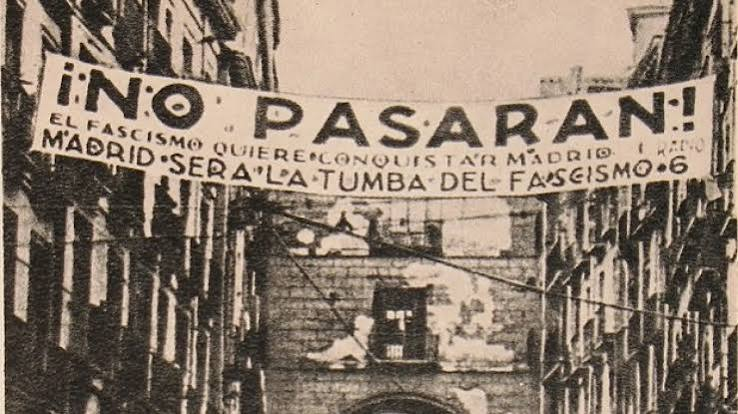
“¡No pasarán!” — “They shall not pass!” — which she had already proclaimed in her appeal of July 1936, became inseparable from the defence of Madrid. It expressed a collective decision: to prevent fascism from taking the city. RTVE: La Pasionaria’s life and speech.
Ibárruri was elected to parliament for Asturias in 1936 and won a seat again in 1977, after her long exile. Her life spanned the Republic, the war, the dictatorship and the return of the exiles. Congress of Deputies: a century of women in parliament.
What Madrid left to the world
Madrid finally fell on 28 March 1939, as the Republic collapsed. The dictatorship subsequently imposed a long repression on the defeated. University of Warwick.
Defeat does not erase the meaning of November 1936. During those days, a threatened city frustrated the plans of those expecting to occupy it quickly. Its resistance gave strength to people watching fascism advance across Europe.
Remembering Madrid means recognising those who sustained its defence: those who fought, organised supplies and cared for the wounded, and those who came from far away to share their fate.
“¡No pasarán!” preserves that memory: of a population that faced an immense threat and organised to resist.