
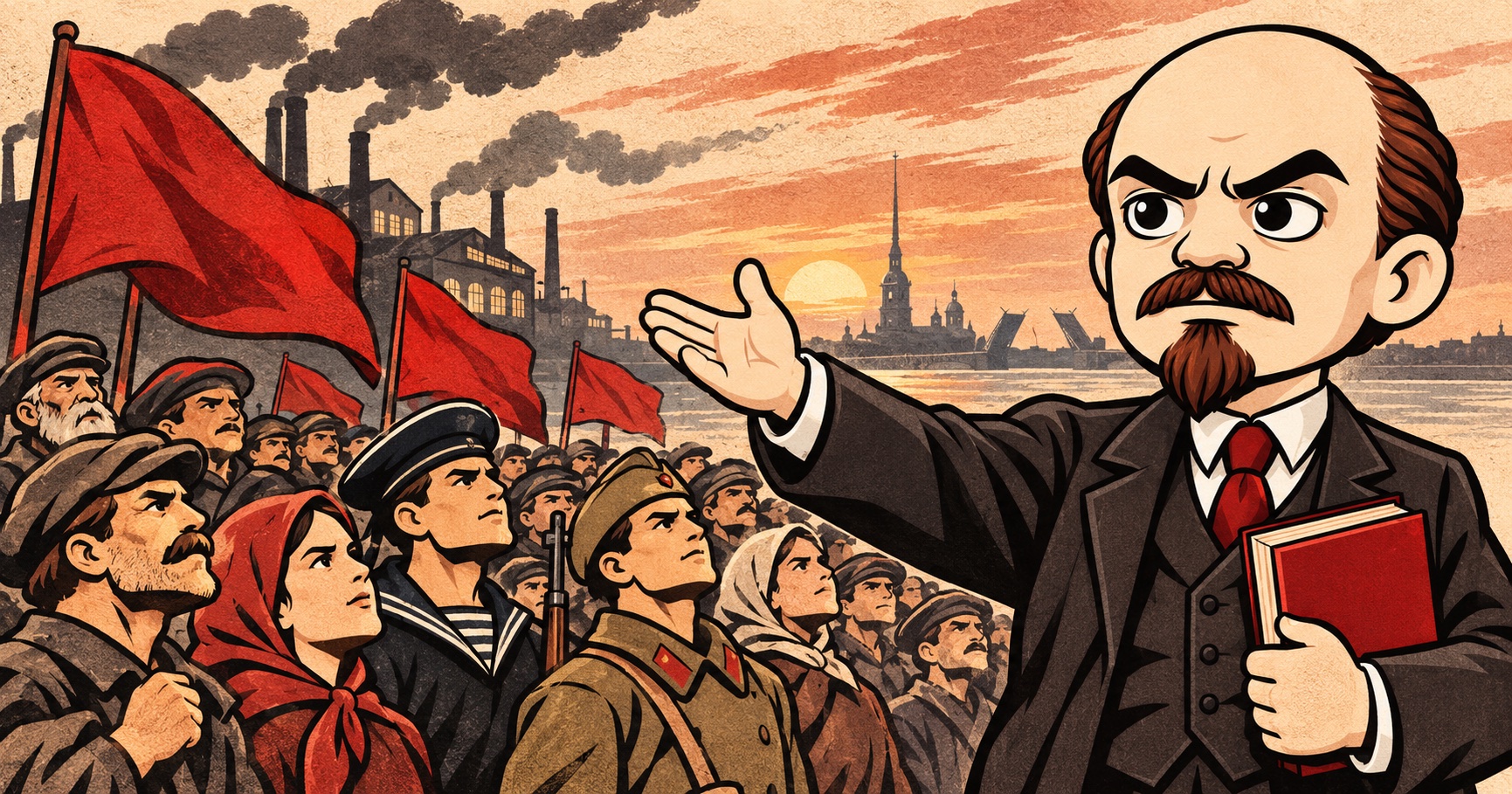
Russia entered 1917 with millions of people caught between war, hunger and a social order that concentrated wealth and decision-making in the hands of a minority. In the cities, working families endured shortages and exhaustion. In the countryside, land remained a source of inequality. At the front, soldiers were dying in a war whose ambitions had little to do with their needs.
From the fall of the tsar to the struggle for power
The revolution began long before the seizure of the Winter Palace. In February, women workers in Petrograd took to the streets demanding bread and brought other sections of the working class into the movement. Strikes and soldiers’ refusal to obey orders helped bring down tsarism. Women remained active throughout the following months, organising protests, sustaining strikes and opposing the continuation of the war. [1]
After the tsar’s fall, the Provisional Government kept Russia in the First World War. Peace and the transformation of land ownership remained unresolved. Meanwhile, the soviets—councils of workers’ and soldiers’ representatives, alongside peasant organisations—provided a base of power rooted in popular mobilisation.
The question was who would have the authority to decide the country’s future. For Lenin, supporting the Provisional Government meant prolonging policies subordinated to the interests of the propertied classes. In his April Theses, he called for power to pass to the soviets, social control over production and a break with the imperialist war. [2]
Peace, bread and land
The Bolshevik slogans connected immediate needs with the question of power.
Peace meant ending the slaughter. Bread expressed the urgent need to feed the population. Land brought together the aspirations of a peasantry subjected for generations to the domination of large landowners.
Meeting these demands required confronting those who profited from the war, controlled resources and owned the great estates. The revolutionary programme united these struggles in a shared project: transferring power to the organisations of workers, soldiers and peasants.
Throughout 1917, Bolshevik organising drew strength from this relationship between political programme and everyday experience. These demands could be discussed in a factory, a barracks or a village because they directly affected the lives of those taking part in the revolution.
The October we commemorate in November
The insurrection took place on 25 October according to the Julian calendar then used in Russia: 7 November in the Gregorian calendar.
The Military Revolutionary Committee of the Petrograd Soviet coordinated the revolutionary forces. Armed workers, soldiers and sailors overthrew the Provisional Government. The proclamation issued that morning announced its fall and linked the new power to peace, the abolition of landed proprietorship and workers’ control over production. [3]
The Second Congress of Soviets established a workers’ and peasants’ government, the Council of People’s Commissars, chaired by Lenin. Under its founding resolution, the government was subject to the supervision of the Congress and its Central Executive Committee. The revolution was beginning to establish institutions capable of turning its programme into government decisions. [4]
The first decisions: transforming relations of power
The Decree on Peace proposed immediate negotiations for peace without annexations or indemnities. It also rejected secret diplomacy and announced the publication of treaties that had negotiated the division of territories and privileges. Its appeal addressed governments, peoples and workers’ organisations in other countries. [5]
The Decree on Land abolished large landed proprietorship without compensation. It placed the estates, together with Crown and religious institutions’ lands, at the disposal of land committees and peasant soviets. It incorporated a mandate compiled from 242 local proposals: peasant demands were acquiring the force of law. Ordinary peasants’ land was protected from confiscation. [6]
In November, the Decree on Workers’ Control recognised the authority of elected workers’ organisations to supervise production, accounts and business operations. Owners were required to provide the necessary documentation, and commercial secrecy was abolished. This opened a struggle over who could scrutinise and shape economic activity. [7]
A revolution with an international horizon
The new government also proclaimed the equality and sovereignty of the peoples of Russia, their right to self-determination, including separation, and the abolition of national and religious privileges. Signed by Lenin and Stalin, the declaration linked social transformation with the emancipation of peoples subjected to the former empire. [8]
Internationalism ran through the October project. The war had demonstrated the destructive reach of rivalry between the great powers. The Bolshevik response appealed to solidarity between workers in different countries and their ability to intervene in the course of history.
The revolution had to defend itself in a civil war accompanied by foreign interventions. British involvement in northern Russia forms part of this documented history of intervention against Bolshevik forces. The struggle and the devastation left by years of war shaped the conditions in which the new state was built. [9]
The meaning of October
October’s historical significance lies in turning popular aspirations into a project to transform the state, property and production. Peace, land and workers’ control expressed a shared ambition: freeing collective life from subordination to the decisions of a propertied minority.
That ambition preserves a decisive question for the present: how much power do those who produce society’s wealth have over the society they sustain?
In 1917, millions of people organised to answer it. October turned that answer into a revolution.
Sources and further reading
- Mary Davis, The Women of the Russian Revolution — Marx Memorial Library
- V. I. Lenin, The Tasks of the Proletariat in the Present Revolution (April Theses), 1917
- Military Revolutionary Committee, To the Citizens of Russia!, 25 October / 7 November 1917
- Second Congress of Soviets, Decision to Form the Workers’ and Peasants’ Government, 1917
- Decree on Peace, 26 October / 8 November 1917
- Decree on Land, 26 October / 8 November 1917
- Decree on Workers’ Control, 14 / 27 November 1917
- Declaration of the Rights of the Peoples of Russia, 2 / 15 November 1917
- The National Archives, Forgotten front: Chinese auxiliaries in northern Russia