
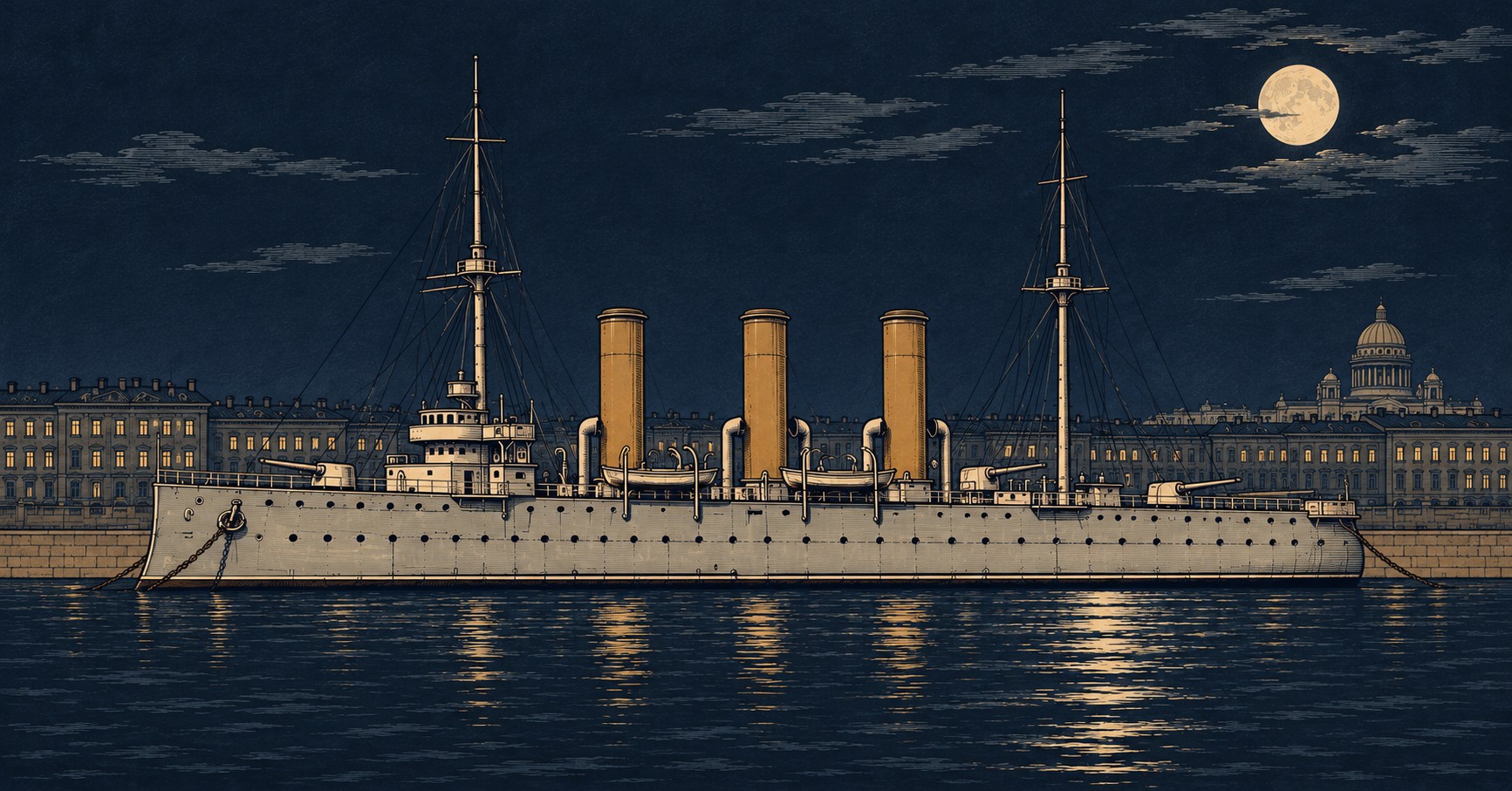
On 7 November 1917, at 9:40 p.m., a gun aboard the cruiser Aurora fired a blank round across Petrograd. The ministers of the Provisional Government remained inside the Winter Palace. Across the city, at the Smolny Institute, the insurrection was being coordinated and delegates to the Congress of Soviets were assembling.
By then, many of the capital’s strategic points were already in revolutionary hands. Months of organisation had prepared the government’s overthrow, which was now unfolding through a succession of concrete operations.
The dates here follow today’s calendar: in Russia at the time, these were 24, 25 and 26 October.
Smolny: organising the insurrection
The Smolny Institute, formerly a school for the daughters of the nobility, had become the headquarters of the Petrograd Soviet. Its rooms and corridors housed meetings, messengers and revolutionary organisations.
It was the base of the Military Revolutionary Committee, attached to the Soviet chaired by Leon Trotsky. The Committee appointed commissars to military units, arms depots and strategic institutions. Its authority rested on a material reality: large numbers of soldiers recognised its decisions and were prepared to carry them out.
Trotsky played a central role in this coordination. But Smolny’s orders could become actions because soldiers’ committees, Bolshevik organisations and mobilised workers stood behind them. The insurrection drew its strength from this connection between political leadership and popular organisation. Trotsky’s account of 1918.
6–7 November: taking control of the city
The government tried to shut down the Bolshevik press. The revolutionary response protected the printing works and restored their operations. The struggle over who could give orders was beginning to be settled on the ground.
During the night, detachments of Red Guards, soldiers and sailors occupied railway stations, bridges, power facilities, depots and communications centres. Controlling these sites allowed them to move forces, maintain supplies, transmit instructions and obstruct the government’s response. Trotsky, “The Conquest of the Capital”.
Everyday life continued in some streets. John Reed, a journalist who witnessed the events, described trams running and shops open while revolutionary forces controlled buildings and access routes. The transfer of power did not look like a battle on every street corner: it also advanced through guards stationed at a doorway and orders the old government could no longer enforce. John Reed, Ten Days That Shook the World.
The morning of 7 November: the government loses control
At ten in the morning, a proclamation written by Lenin and issued in the name of the Military Revolutionary Committee announced the overthrow of the Provisional Government and the transfer of power to the Committee.
The ministers were still inside the Winter Palace. The declaration expressed a shift in the effective centre of authority: the government could still hold its meeting, but it was losing the means to govern the capital.
The proclamation linked the seizure of power to immediate objectives: proposing peace, abolishing landed proprietorship, establishing workers’ control over production and instituting Soviet power. Lenin, “To the Citizens of Russia!”.
The Aurora: a ship within the operation
The Aurora took part in the events before its famous shot. On the morning of 7 November, it anchored beside the Nikolayevsky Bridge; members of its crew went ashore, and its electricians helped restore passage across the bridge. Its radio station also broadcast the proclamation sent from Smolny.
At 9:40 p.m., gunner Yevdokim Ognev, acting on the order of commissar Alexander Belyshev, fired the 152-millimetre bow gun. Central Naval Museum, Aurora exhibition.
It was a blank round, used as a signal and to put pressure on the palace’s defenders. The insurrection had already been under way for hours. That thunderous report condensed a much wider operation into a memorable instant. Trotsky, “The Capture of the Winter Palace”.
The early hours of 8 November: the ministers are arrested
The encirclement of the palace had dragged on through ultimatums, delays, gunfire and the departure of some of its defenders. Kerensky had left Petrograd to seek forces with which to regain control.
During the night, revolutionaries made their way into the building. The remaining resistance weakened until a group led by Vladimir Antonov-Ovseenko reached the ministers, who had gathered in the Small Dining Room.
At around 2:10 a.m. on 8 November, they were arrested. Trotsky reconstructed this moment in his history of the revolution; the Hermitage identifies the Small Dining Room as the site of the arrest and notes that, by then, most of the defenders had left the palace. Trotsky; Hermitage Museum.
The entry into the palace completed the government’s isolation. Its defeat had begun long before the revolutionaries reached that room.
As the palace fell, the Congress was meeting
At Smolny, the Second Congress of Soviets of Workers’ and Soldiers’ Deputies was debating the power that should emerge from the insurrection.
The divisions were profound: Menshevik and Right Socialist-Revolutionary delegates rejected the uprising and walked out of the Congress. Those who remained continued its work and supported the establishment of Soviet power. John Reed.
The following sessions brought fundamental decisions: the Decree on Peace, the Decree on Land and the formation of the Council of People’s Commissars, headed by Lenin. Victory in the streets was giving way to measures of government. Documents of the Second Congress.
The Winter Palace became the image of the old power’s fall; Smolny was where the insurrection was organised and the new power began to take shape.
The night of the Aurora shows how a social force becomes political power: workers keeping their presses running, soldiers recognising a new authority, sailors securing a bridge and delegates turning victory into decisions.
The shot lived on in memory. Organisation made it possible for that night to change history.