
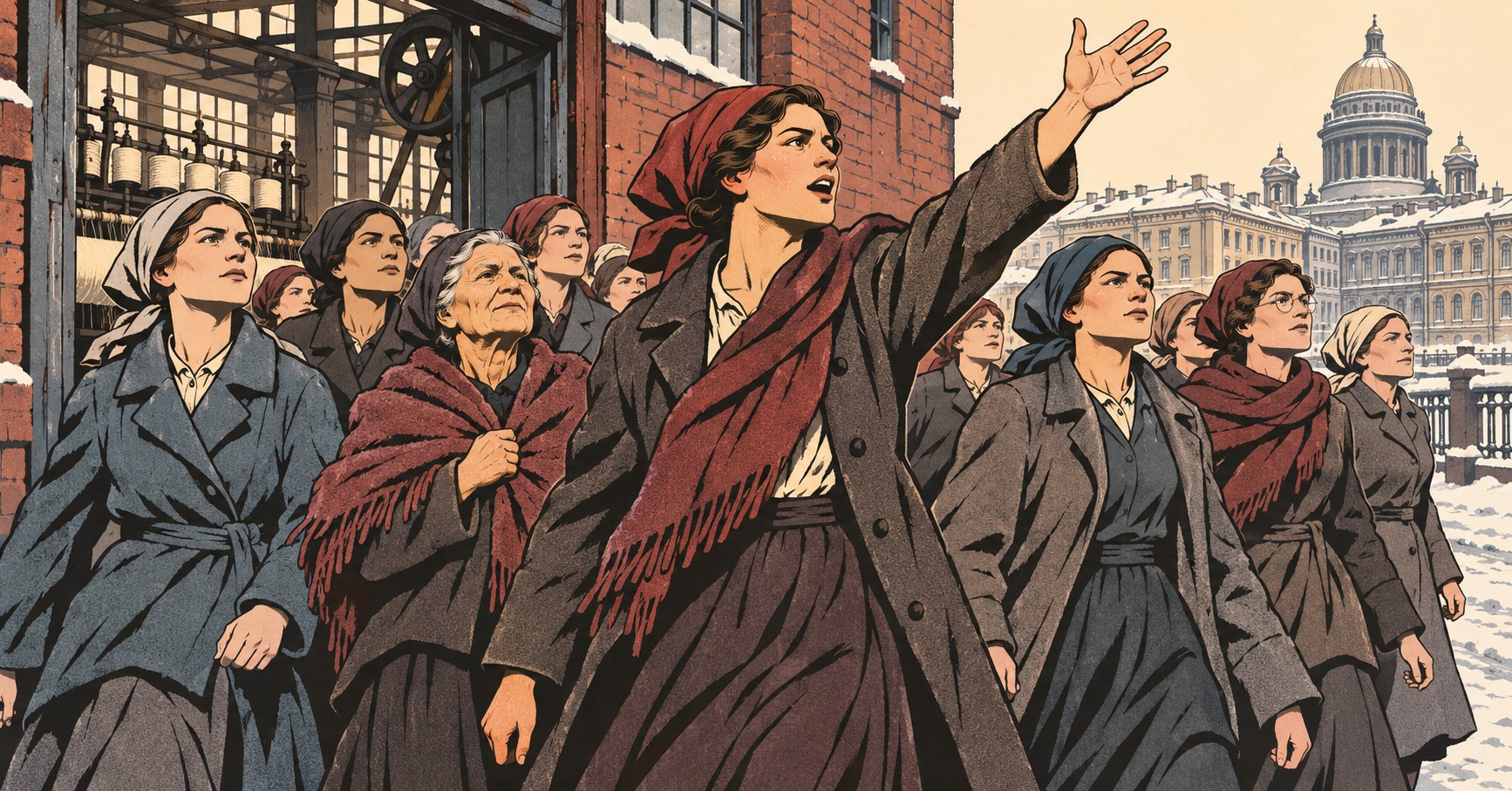
The women workers who set the revolution in motion
On 8 March 1917—23 February under the Russian calendar of the time—the women textile workers of Petrograd left their factories and took to the streets. They demanded bread, protested against the war and called on other workers to join them.
They knew exploitation in the workshops, endless queues for food and the effort of sustaining households torn apart by poverty and military mobilisation. Their protest turned those experiences into a collective force.
The strike spread and helped trigger the February Revolution, which overthrew the Tsar. Years later, Kollontai would remember that International Working Women’s Day as the beginning of a historic rupture. Alexandra Kollontai, “International Women’s Day”, 1920.
Women participated throughout the revolutionary process: they organised strikes and meetings, distributed newspapers, appealed to soldiers and sustained political networks in working-class neighbourhoods. During October and the subsequent defence of the revolution, they served as activists, messengers, medical workers, organisers and combatants.
Alongside well-known figures such as Kollontai, Inessa Armand, Nadezhda Krupskaya and Konkordia Samoilova were thousands of women workers whose names barely appear in the grand historical narratives. Kollontai insisted on restoring their place at the centre of the story: the revolution had also been the work of those anonymous women. “Women Fighters in the Days of the Great October Revolution”, 1927.
A revolution that had to enter everyday life
The fall of Tsarism opened the way to political rights, including women’s suffrage, won in 1917 before October. With Soviet power, the transformation extended into marriage, education, work, health and social protection.
For Kollontai, legal equality had to be accompanied by economic independence and collective services. A woman could have rights on paper while continuing to depend on a husband for food, housing or the means to raise her children.
Moreover, working outside the home did not eliminate the hours of cooking, cleaning and care that still fell to her. Emancipation required time to study, rest, organise and participate in collective decisions.
Hence her advocacy of nurseries, communal dining rooms and laundries: turning isolated domestic tasks into social services would expand working women’s freedom. In Communism and the Family, she linked that reorganisation of daily life to a new relationship between women, men and the community. Kollontai, 1920.
Some achievements of the revolution and the Soviet experience
The first reforms began in Soviet Russia and were subsequently developed in the USSR. Among its most important advances were:
Civil equality and the transformation of marriage. The decrees of December 1917 and the Family Code of 1918 established civil marriage, made divorce easier and abolished the legal distinction between children born within and outside marriage. Separation no longer depended on religious authority or procedures that particularly penalised poor women.
The legalisation of abortion in public hospitals in 1920. Soviet Russia became the first state to legalise abortion broadly and provide it free of charge in public institutions. The measure addressed the deaths and injuries caused by clandestine procedures. Its regulation subsequently changed: the general prohibition introduced in 1936 was lifted in 1955. Decree on the Protection of Women’s Health, 18 November 1920.
Maternity protection and paid leave. Pregnancy, childbirth and recovery became responsibilities of the social protection system. Legislation introduced leave, benefits and workplace protections. Kollontai was a particularly strong advocate of this change in the first months of Soviet power. “The First Steps Towards the Protection of Motherhood”, 1918.
Nurseries and collective services. The expansion of childcare centres and other care institutions provided a material foundation enabling women to work, pursue education and participate in public life. The Soviet Constitution of 1936 expressly provided for maternity homes, nurseries and kindergartens.
Education and vocational training. Literacy campaigns and the expansion of education opened opportunities for working-class and peasant women. The right to education became part of the project of equality, alongside access to professions and responsibilities previously reserved predominantly for men.
Work, pay and social security as rights. The Constitution of 1936 recognised women’s equality in employment, remuneration, rest, education and social protection. Economic independence thus acquired a public dimension. Soviet Constitution, Article 122.
Participation in administration and political organisation. Councils of women delegates and departments for work among women brought working-class and peasant women into the inspection of institutions, the management of services and the construction of the new state. Kollontai, “The Woman Worker and Peasant in Soviet Russia”, 1921.
New scientific and technical horizons. In 1963, Valentina Tereshkova, who had worked in the textile industry, became the first woman to travel into space. Her flight gave worldwide expression to women’s ability to participate in the most advanced scientific endeavours of their time. European Space Agency.
These advances required institutions, resources and organisation. Equality had to be built in schools, workplaces, hospitals, homes and spaces of decision-making.
What Alexandra Kollontai helped bring about
After October, Kollontai was appointed People’s Commissar for Social Welfare. She became the first woman to head a ministry in a national government.
Her responsibilities encompassed people wounded in the war, children without support and other groups in need of protection. She argued that assistance should cease to depend on charity and be organised as a collective responsibility.
Her concrete initiatives included:
- The creation of a central body for the protection of maternity and infancy, to coordinate scattered services.
- The reorganisation of maternity hospitals as centres providing free care, accessible to working women and poor women.
- The transformation of former orphanages and the opening of accommodation for homeless children.
- Improvements in assistance for people disabled by the war.
- Reforms in the girls’ educational institutions under her commissariat, including the abolition of compulsory religious instruction and students’ participation in their organisation.
Kollontai described these measures in her autobiography and placed public protection for mothers and children among the principal achievements of her ministerial work. Autobiography, 1926.
She also helped build the organised work among women that led to the Zhenotdel, established in 1919 and initially headed by Inessa Armand. Kollontai subsequently assumed its leadership.
Its networks of delegates sought to ensure that women workers understood their new rights and gained practical experience in public administration. Women’s organisation was also intended to advance new measures and demand their implementation.
The freedom to choose one’s own life
Kollontai’s contribution extended to personal relationships. She defended women’s autonomy against economic dependence and challenged a morality that tolerated freedoms for men while demanding obedience and sacrifice from women.
For her, love and living together should rest on relationships between people with material autonomy. Having an income, education and social support expanded the ability to decide whom to live with, when to separate and what course to pursue in life.
This perspective made it possible to see women as complete human beings: workers, leaders, creators, partners and citizens, with the right to a life of their own.
What changed for women around the world
The Soviet experience gave international scope to a fundamental question: what conditions make it possible to exercise a right?
The existence of paid leave, public healthcare and collective care offered concrete arguments to those fighting for similar measures elsewhere. Kollontai understood October as a force capable of changing expectations about women’s place throughout society. “What Has the October Revolution Done for Women in the West?”, 1927.
Socialist and communist women’s organisations subsequently helped spread these demands through international networks. One example was the Women’s International Democratic Federation, whose proposal to the United Nations helped bring about the proclamation of 1975 as International Women’s Year. History of the Commission on the Status of Women, United Nations.
International advances were the product of struggles in many countries. The revolution and the Soviet experience contributed a precedent of immense power to those struggles: the possibility of organising the economy, services and political power around needs that had for centuries been relegated to the private sphere.
A legacy that still challenges us
The women workers of 1917 intervened in the course of history. Kollontai devoted much of her life to turning that revolutionary force into rights, organisation and everyday autonomy.
Her legacy raises questions that remain open: who provides care, who has time, who can study, who depends economically on another person and who participates in decision-making?
Emancipation requires the transformation of those relationships. That was the horizon the Russian Revolution opened for millions of women: the possibility of winning, alongside political power, the material conditions for a life of freedom.